
Key takeaways
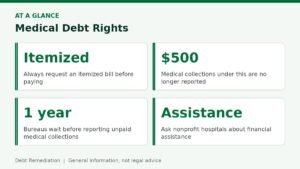
- Medical bills frequently contain errors, including duplicate charges, services you didn’t receive, and claims that should have been paid by insurance. Always request an itemized bill.
- Nonprofit hospitals must have financial assistance policies and generally must give you time to apply before using extraordinary collection actions like lawsuits or credit reporting.
- The federal No Surprises Act protects many patients from surprise out-of-network bills and gives uninsured and self-pay patients the right to a good faith estimate.
- The three major credit bureaus no longer report paid medical collections or medical collections with an initial balance under $500, and they wait a year before reporting unpaid ones.
- Once a medical bill goes to a third-party collector, you have the same FDCPA rights as with any consumer debt, including the right to request validation.
Medical debt is different from other kinds of debt. Nobody plans a trip to the emergency room or compares prices before surgery. Bills often arrive weeks or months later, from multiple providers, with codes that are hard to read and amounts that change after insurance processing.
It is also one of the most common reasons Americans are contacted by debt collectors. The good news: medical debt comes with more opportunities to challenge, reduce or resolve the bill than almost any other type of debt, if you know where to look.
Step 1: Don’t pay a medical bill you don’t understand
Before paying anything, make sure the bill is correct and final. Many patients pay bills that insurance should have covered, or pay amounts that would have been reduced or forgiven if they had asked.
Request an itemized bill
A summary statement shows only a total. An itemized bill lists every charge, with dates, descriptions and billing codes. Ask the provider’s billing office for one in writing. You have a right under HIPAA to access your own billing records.
Review it line by line for:
- Duplicate charges for the same service or supply;
- Services you did not receive, such as medications you never took or tests that were cancelled;
- Incorrect dates (for example, a charge for a day after you were discharged);
- Upcoding, where a service is billed as more complex than what was provided;
- Unbundling, where services that should be billed together are billed separately at higher cost; and
- Charges for items included in a room rate.
Compare with your insurance Explanation of Benefits
If you have insurance, compare the itemized bill with the Explanation of Benefits (EOB) from your insurer. The EOB shows what was billed, what the insurer allowed, what it paid, and what you owe. If the provider’s bill is higher than your EOB says you owe, ask why.
Check whether the claim was submitted correctly
Common insurance problems include: – the claim was never submitted or was sent to the wrong insurer; – a coding error caused a denial; – the provider was treated as out of network when it should not have been; or – prior authorization was missing.
You can ask the provider to resubmit, and you can appeal an insurer’s denial. Many denials are overturned on appeal.
Step 2: Know your rights under the No Surprises Act
The federal No Surprises Act, effective since 2022, protects many patients from unexpected out-of-network bills:
- Emergency services: You generally cannot be billed more than in-network cost-sharing for emergency care, even at an out-of-network hospital.
- Out-of-network providers at in-network facilities: For many services, such as anesthesia, radiology or lab work at an in-network hospital, out-of-network providers generally cannot “balance bill” you beyond in-network cost-sharing unless you gave valid advance written consent where permitted.
- Air ambulances: Out-of-network air ambulance services are also covered by the protections.
If you are uninsured or paying out of pocket, providers must give you a good faith estimate of expected charges for scheduled services. If your final bill is at least $400 more than the estimate from a provider, you may be able to use the federal patient-provider dispute resolution process. You generally must start it within 120 calendar days of receiving the bill.
If you believe you received a surprise bill, contact the No Surprises Help Desk through CMS or your state insurance regulator.
Step 3: Apply for hospital financial assistance
Many patients qualify for free or discounted care and never apply.
Nonprofit hospitals
Under federal tax law (Internal Revenue Code Section 501(r)), nonprofit hospitals must:
- maintain a written financial assistance policy (FAP) describing eligibility criteria and how to apply;
- widely publicize the policy, including plain-language summaries;
- limit charges to FAP-eligible patients to no more than amounts generally billed to insured patients; and
- make reasonable efforts to determine FAP eligibility before taking extraordinary collection actions, such as selling the debt, reporting it to credit bureaus, suing, or garnishing wages.
Generally, a nonprofit hospital must accept financial assistance applications for at least 240 days after the first post-discharge billing statement, and may not begin extraordinary collection actions until at least 120 days after that first statement, with advance notice. If you apply during the application period, the hospital generally must suspend extraordinary collection actions while it reviews the application.
Even if your bill is already in collections, ask the hospital whether you can still apply. If you qualify, the hospital may have to reverse collection actions and refund amounts you paid above what you owe under the policy.
For-profit hospitals and other providers
For-profit hospitals, doctors’ offices and labs are not covered by Section 501(r), but many have charity care or discount programs. Some states also require all hospitals to offer financial assistance. Massachusetts residents with limited income, for example, may be eligible for programs such as the state’s Health Safety Net for qualifying services at community health centers and hospitals.
Step 4: Negotiate before it goes to collections
If the bill is correct and you don’t qualify for assistance, you still have options:
- Ask for a prompt-pay or self-pay discount. Many providers offer reductions for uninsured patients or for paying a lump sum.
- Ask for an interest-free payment plan. Many hospitals offer them directly. Be cautious about medical credit cards or financing offered at the front desk; they may carry deferred interest that becomes expensive if the balance isn’t paid in full by the end of a promotional period.
- Ask what the provider accepts from insurers or Medicare. Asking to pay a comparable rate can be a reasonable starting point.
Get any agreement in writing before you pay.
Step 5: If the bill goes to collections
Once a medical bill is assigned or sold to a third-party collector, the Fair Debt Collection Practices Act (FDCPA) and Regulation F apply. That means you have the right to:
- receive a validation notice with an itemization of the debt;
- dispute the debt within 30 days and require the collector to verify it before continuing collection;
- be free from harassment and deceptive practices; and
- control how and when you are contacted.
Medical collection accounts are especially prone to errors, such as balances that do not reflect insurance payments or adjustments. A debt validation letter is often the first step. Ask for an itemized statement from the original provider showing charges, insurance payments, adjustments and the remaining balance.
Collectors also may not collect amounts the provider is prohibited from collecting, such as balance billing that violates the No Surprises Act.
For more on illegal tactics, see our guide to debt collector harassment.
Medical debt and your credit report
Medical debt reporting has changed significantly in recent years:
- Since 2022, the three nationwide credit bureaus (Equifax, Experian and TransUnion) remove paid medical collection debt from credit reports and wait one year before unpaid medical collection debt can appear.
- Since 2023, they do not include medical collection debt with an initial reported balance under $500.
- In January 2025, the CFPB finalized a rule that would have removed most medical debt from credit reports used by lenders. A federal court vacated that rule in July 2025, so the voluntary bureau policies above, plus state laws, remain the main protections.
- A growing number of states, including Colorado, Minnesota and New York, restrict or prohibit reporting medical debt to credit bureaus. Check your state’s rules.
If a medical collection appears on your report and it is paid, under $500, less than a year old, or otherwise inaccurate, dispute it. Our guide to disputing a collection account on your credit report explains how.
If you are sued over medical debt
Hospitals and debt buyers do sometimes sue patients. If you receive a summons:
- Respond by the deadline. Missing it can result in a default judgment.
- Raise any defenses, including billing errors, insurance responsibilities, financial assistance eligibility and the statute of limitations.
- Ask whether the hospital followed its financial assistance and collection policies. For nonprofit hospitals, failure to follow Section 501(r) rules can be relevant.
- Consider legal help. Legal aid organizations often assist with medical debt cases.
See our guide on how to answer a debt collection lawsuit.
A medical debt checklist
Once you know what you owe, the free Debt Payoff Calculator on our sister site, Debt Remediation Tools, can help you plan realistic payments across multiple medical bills.
Plan what you can realistically pay
Once you know what you actually owe, use the free Debt Payoff Calculator to see how different monthly payments change your payoff date, and the Debt-to-Income Calculator to see how much of your income your debts take.
Frequently asked questions
It may happen, but you can dispute the debt and ask the provider to recall it from collections while the claim is pending. Nonprofit hospitals are restricted from extraordinary collection actions during the financial assistance notification period.
Paid medical collections, medical collections under $500 and unpaid medical collections less than a year old should not appear on your reports with the three major bureaus. Larger unpaid medical collections may still appear, subject to state law.
Possibly. Ask the hospital. If you qualify within the application period, you may be entitled to a refund of amounts paid above what you owed under the policy.
Yes. Medical debts are subject to your state’s statute of limitations for lawsuits, which varies.
The bottom line
Medical bills are not take-it-or-leave-it demands. They are often wrong, frequently negotiable, and backed by patient protections that many people never use. Ask for itemized bills, check insurance carefully, apply for financial assistance, and insist on validation if a bill reaches a collector.
If medical collections are adding up and you want help organizing your records and challenging inaccurate claims, contact Debt Remediation.
This article is for general educational purposes and is not legal, tax or medical billing advice. Debt Remediation is a service of Foxboro Consulting Group, Inc. and is not a law firm. Federal and state rules change; verify current requirements and consult a licensed professional about your situation.