
Key takeaways
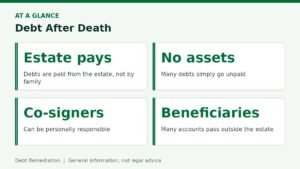
- In most situations, you do not inherit a loved one’s debts. Debts are paid from the deceased person’s estate, the property they left behind.
- If the estate does not have enough money, many debts simply go unpaid, and family members are generally not required to cover the difference.
- You may be responsible if you were a co-signer or joint account holder, live in a community property state (for a spouse’s debts), are liable under certain state laws, or are an executor who mishandles estate funds.
- Debt collectors may contact the person handling the estate, but they may not mislead family members into thinking they must pay from their own money.
- Assets with named beneficiaries, such as life insurance and many retirement accounts, often pass outside the estate and are generally protected from the deceased person’s creditors.
Losing a parent or spouse is hard enough. Then the mail starts arriving: credit card statements, medical bills, collection letters. Sometimes a collector calls and says something like “We’d like to discuss how you plan to take care of your mother’s account.”
Many grieving family members pay those bills out of a sense of obligation, or because they believe they have to. Often, they don’t.
This guide explains how debts are handled after someone dies, when family members can be responsible, and how to respond to collectors.
How debts are paid after death: the estate
When someone dies, everything they owned in their name alone, such as bank accounts, a house, a car, investments and personal belongings, generally becomes part of their estate. The estate is responsible for paying the person’s valid debts before anything is distributed to heirs.
The process usually works like this:
- A personal representative is appointed. This is the executor named in a will, or an administrator appointed by the court if there is no will. (In Massachusetts, the term is “personal representative.”)
- Assets are gathered and valued.
- Creditors are notified and given a deadline to submit claims. In Massachusetts, for example, creditors generally must bring claims within one year of the date of death.
- Valid debts are paid from estate assets, in an order of priority set by state law. Funeral expenses, administration costs and certain taxes typically come before unsecured debts like credit cards.
- What remains is distributed to heirs and beneficiaries.
What if there isn’t enough money?
If the estate is insolvent, meaning debts exceed assets, the personal representative pays debts in the priority order set by law until the money runs out. Remaining unpaid debts are generally written off. Family members do not have to make up the shortfall from their own money unless one of the exceptions below applies.
When you could be personally responsible
You co-signed the loan
A co-signer is equally responsible for the debt. If you co-signed a car loan, personal loan or private student loan, the creditor can generally collect the full balance from you.
You were a joint account holder
If you were a joint owner of a credit card or loan account, you are typically responsible for the balance. Note the difference: an authorized user on someone else’s credit card is generally not responsible for the debt.
You live in a community property state (spouses)
In community property states, debts incurred during the marriage may be considered shared, even if only one spouse signed. These states are Arizona, California, Idaho, Louisiana, Nevada, New Mexico, Texas, Washington and Wisconsin. Alaska allows couples to opt in. If your spouse died in one of these states, a surviving spouse may be responsible for some debts. Rules are complex, so consult an attorney.
State law requires a spouse to pay certain debts
Some states make spouses responsible for certain “necessaries,” such as medical care, in limited circumstances.
Filial responsibility laws
Roughly half of U.S. states have filial responsibility laws that can, in rare circumstances, require adult children to pay for an indigent parent’s care, such as nursing home costs. They are seldom enforced, but they exist. If a nursing home or care provider claims you are personally liable, get legal advice.
You’re the executor and you mishandle the estate
As personal representative, you are not personally liable for the estate’s debts simply because of your role. However, if you distribute assets to heirs before paying valid creditors or before the claims period ends, you could become personally liable for amounts that should have gone to creditors.
You signed an admission agreement as “responsible party”
Nursing home admission paperwork sometimes asks a family member to sign as the “responsible party.” Federal law generally prohibits nursing homes that accept Medicare or Medicaid from requiring a third-party guarantee of payment as a condition of admission, but signing as a representative who agrees to use the resident’s funds to pay can create obligations. Read what you signed and get advice if you are pursued.
What happens to specific types of debt
| Type of debt | What usually happens |
|---|---|
| Credit cards (individual) | Paid from the estate. If the estate can’t pay, usually written off. Authorized users aren’t liable. |
| Mortgage | The loan stays attached to the house. Heirs who inherit the home can usually keep paying the mortgage. Under the federal Garn-St Germain Act, lenders generally cannot call the loan due just because a relative inherits the home. |
| Car loan | Secured by the car. The estate or heir can pay it off, continue payments, or let the lender repossess. |
| Federal student loans | Generally discharged upon the borrower’s death with proof of death. Parent PLUS loans are discharged if the parent or the student dies. |
| Private student loans | Depends on the lender and loan date. For private loans made after November 20, 2018, federal law requires release of a co-signer if the student borrower dies. Older loans vary. |
| Medical bills | Paid from the estate. States may also seek Medicaid estate recovery for certain long-term care costs paid by Medicaid. |
| Taxes | The estate must file the final income tax return and pay taxes owed before distributing assets. |
Assets that often pass outside the estate
Some assets transfer directly to named beneficiaries or co-owners and generally are not available to pay the deceased person’s ordinary creditors:
- Life insurance with a named beneficiary;
- Retirement accounts (401(k)s and IRAs) with named beneficiaries;
- Payable-on-death (POD) and transfer-on-death (TOD) accounts;
- Jointly owned property with right of survivorship; and
- Certain trusts.
There are exceptions, such as when the estate is named as beneficiary, and state law varies. But in many cases, a life insurance payout to you is yours, not the creditors’.
What debt collectors can and can’t do
What they can do
Under the Fair Debt Collection Practices Act and federal guidance, a collector may contact: – the personal representative (executor or administrator), or anyone with authority to pay debts from the estate; and – a surviving spouse, and in some cases the parent of a deceased minor, or a guardian.
They may also contact other relatives once, to locate the person handling the estate, but generally may not discuss the debt with them.
What they can’t do
Collectors may not: – tell you, or imply, that you are personally responsible if you are not; – pressure you to pay from your own money out of guilt or “family obligation”; – misrepresent the legal status of the debt; or – harass, threaten or use deceptive practices.
If a collector suggests you must pay a deceased relative’s debt when you are not legally responsible, write down what was said, when and by whom. That conduct may violate federal law. See our guide to debt collector harassment.
What to do if collectors contact you
- Don’t agree to pay on the call. Say you need information in writing.
- Ask who they are and what they want. Request the creditor name, account number and amount claimed.
- Clarify your role. If you are not the personal representative, say so. If you are, let them know an estate is being administered and give the estate’s address for claims.
- Request validation if you are the personal representative and the debt is unfamiliar. A debt validation letter can ask the collector to prove the debt.
- Send a written request to stop contact if you are not responsible and want calls to end. Our guide to cease-and-desist letters explains how.
- Never pay from your own funds unless you have confirmed you are legally responsible.
Practical steps after a loved one dies
- Get multiple certified copies of the death certificate. You will need them for banks, creditors and agencies.
- Notify the credit bureaus (Equifax, Experian and TransUnion) and ask them to flag the credit report as “deceased” to reduce the risk of identity theft.
- Notify creditors in writing and provide a copy of the death certificate.
- Cancel or close accounts in the deceased person’s name alone. Remove authorized users from cards.
- Keep estate money separate from your own; open an estate account if you are the personal representative.
- Don’t distribute assets to heirs until valid debts are paid and the claims period has passed.
- Keep records of every letter, call and payment.
- Talk to a probate attorney if the estate is complex, insolvent, or includes real estate.
Related guide
Our sister site, Debt Remediation Tools, has a plain-English companion guide: what happens to debt when someone dies.
Frequently asked questions
Generally no, unless you were a co-signer or joint account holder. The debt is paid from his estate. If the estate can’t pay it, it is usually written off.
Valid debts are paid from the estate before inheritances are distributed, so your inheritance may be smaller. But collectors generally can’t come after your own assets.
It depends on whether the debt was joint, whether you live in a community property state, and state law. Individual debts are usually the estate’s responsibility.
You are not legally required to pay debts you are not responsible for. Misleading you about your legal obligation may violate the FDCPA.
Possibly. Creditors sometimes issue a Form 1099-C for forgiven debt. Learn more in our guide to 1099-C and canceled debt, and speak with a tax professional.
The bottom line
Grief is not a debt. In most cases, a loved one’s debts are settled through their estate, and family members are not personally responsible. Know your role, ask for information in writing, don’t pay from your own funds unless you’re legally obligated, and get professional help when the estate is complicated.
If collectors are contacting you about a deceased family member’s debts and you need help organizing records and responding in writing, contact Debt Remediation.
This article is for general educational purposes and is not legal or tax advice. Debt Remediation is a service of Foxboro Consulting Group, Inc. and is not a law firm. Probate and debt rules vary by state; consult a licensed probate or consumer attorney about your specific situation.