
Key takeaways
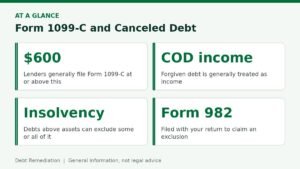
- When a lender forgives or settles a debt for less than you owe, the IRS generally treats the forgiven amount as income. This is called cancellation of debt (COD) income.
- Lenders generally must file Form 1099-C when they cancel $600 or more of debt, and send you a copy.
- You may be able to exclude some or all of the canceled amount, most commonly under the insolvency exclusion (when your debts exceed your assets) or because the debt was discharged in bankruptcy.
- To claim an exclusion, you generally file Form 982 with your tax return.
- If you receive a 1099-C that is wrong, contact the creditor right away and keep records. Don’t ignore it.
Settling a credit card for half the balance can feel like a victory. Then, early the next year, an envelope arrives with an IRS form you’ve never seen: Form 1099-C, Cancellation of Debt. Suddenly the $5,000 you “saved” shows up as income.
Taxes on canceled debt surprise many consumers. But the rules include important exceptions, and many people who settle debts during financial hardship owe little or nothing once they apply them correctly. This guide explains how it works.
Why canceled debt can be taxable
When you borrowed the money, you didn’t pay tax on it because you were expected to repay it. If part of that obligation is later forgiven, you have received a financial benefit you never paid tax on. Under the Internal Revenue Code, that benefit is generally treated as gross income.
Common situations that can create COD income include:
- Debt settlement, when a creditor accepts less than the full balance;
- Charge-off and cancellation, when a creditor decides to stop collecting and formally cancels the debt;
- Foreclosure or short sale where the lender forgives a deficiency;
- Repossession where a deficiency balance is forgiven; and
- Loan modifications that reduce principal.
What is Form 1099-C?
Form 1099-C is an information return that certain creditors, such as banks, credit unions, credit card issuers and some debt buyers, must file with the IRS when they cancel $600 or more of debt. You receive a copy, usually by January 31 of the year after the cancellation.
Key boxes include:
| Box | What it shows |
|---|---|
| Box 1 | Date of identifiable event (when the debt was considered canceled) |
| Box 2 | Amount of debt discharged |
| Box 3 | Interest included in Box 2, if any |
| Box 5 | Whether you were personally liable for repayment |
| Box 6 | Identifiable event code (for example, bankruptcy, statute of limitations expiration, or a creditor decision to discontinue collection) |
| Box 7 | Fair market value of property (for foreclosures and similar events) |
Even if you do not receive a 1099-C, canceled debt may still be taxable. The form is how the IRS finds out; it is not what makes the income taxable.
Exclusions: when canceled debt is not taxable
Section 108 of the Internal Revenue Code provides several exclusions. The most common for consumers are:
1. Bankruptcy
Debt discharged in a Title 11 bankruptcy case is not taxable. You still report the exclusion on Form 982.
2. Insolvency
If you were insolvent immediately before the debt was canceled, you can exclude canceled debt up to the amount by which you were insolvent.
You are insolvent when your total liabilities exceed the fair market value of your total assets.
3. Other exclusions
Other exclusions apply in specific situations, such as certain farm debt, qualified real property business debt, and, for qualifying discharges through 2025, qualified principal residence indebtedness (mortgage debt on a main home). Congress has extended or changed some of these provisions several times, so confirm current law for the year of your cancellation.
Some debts are not COD income at all, such as debts canceled as a gift, or certain amounts that would have been deductible if you had paid them. A genuinely disputed debt that you settle may also be treated differently. These situations are technical; ask a tax professional.
How the insolvency exclusion works: an example
Maria settles two credit cards in 2026. One creditor forgives $6,000 and the other forgives $4,000, for a total of $10,000 in canceled debt.
Immediately before the cancellations, Maria’s finances looked like this:
Liabilities | Item | Amount | |—|—| | Credit card A (before settlement) | $9,000 | | Credit card B (before settlement) | $7,000 | | Car loan | $14,000 | | Medical bills | $3,000 | | Personal loan | $12,000 | | Total liabilities | $45,000 |
Assets (fair market value) | Item | Amount | |—|—| | Car | $11,000 | | Checking and savings | $1,500 | | 401(k) balance | $22,000 | | Household goods and personal property | $3,500 | | Total assets | $38,000 |
Insolvency = $45,000 − $38,000 = $7,000
Maria can exclude $7,000 of the $10,000 in canceled debt. The remaining $3,000 is taxable income.
Note that retirement accounts count as assets for the insolvency calculation, even though they may be protected from creditors. So do assets like vehicles and household goods. Many people overlook this.
A net worth statement is the starting point for this calculation. In simple terms, add up everything you own and everything you owe as of the day before the debt was canceled.
The IRS provides an insolvency worksheet in Publication 4681, Canceled Debts, Foreclosures, Repossessions, and Abandonments. Complete it and keep it with your tax records.
How to claim an exclusion: Form 982
To exclude canceled debt from income, you generally attach Form 982, Reduction of Tax Attributes Due to Discharge of Indebtedness, to your federal tax return:
- Check the box for the exclusion that applies (for example, Line 1a for bankruptcy or Line 1b for insolvency).
- Enter the excluded amount on Line 2.
- Complete the sections on reduction of tax attributes if required. Excluding COD income can reduce certain tax benefits, such as net operating losses, credits, or the basis of property you own.
Any canceled debt you cannot exclude is generally reported as other income on your return.
Factor taxes into any debt settlement decision
When comparing settlement offers, think about the after-tax cost. Consider this simplified example:
| Amount | |
|---|---|
| Original balance | $20,000 |
| Settlement payment | $10,000 |
| Debt forgiven | $10,000 |
| Possible federal tax at a 22% bracket (if no exclusion applies) | $2,200 |
| Total cost: settlement + tax | $12,200 |
If you were insolvent by at least $10,000, the tax could be $0. If you were solvent, it could be meaningful. State income tax may also apply depending on where you live.
Our sister site, Debt Remediation Tools, explains how debt settlement works, and its Debt Payoff Calculator can help you plan payments on any balance that remains.
What if your 1099-C is wrong?
Errors are common, especially when debts have been sold several times. Watch for:
- the wrong amount in Box 2;
- a debt you already paid or settled for a different amount;
- a debt that isn’t yours;
- a wrong year; or
- duplicate 1099-Cs from both the original creditor and a debt buyer for the same debt.
What to do: 1. Contact the creditor that issued the form, in writing, and ask it to issue a corrected 1099-C. Include supporting documents. 2. Keep records of your request and any response. 3. If the creditor won’t correct it, report the correct amount on your return and attach an explanation, with documentation. A tax professional can help you present this properly. 4. If the debt resulted from identity theft, file a report at IdentityTheft.gov and note it in your correspondence.
Does a 1099-C mean the debt can’t be collected anymore?
Not necessarily. A 1099-C reports an “identifiable event” for tax purposes. Courts have reached different conclusions about whether issuing a 1099-C legally prevents a creditor from continuing to collect. If you receive a 1099-C and are later contacted about the same debt, keep copies of the form and consider getting legal advice. At a minimum, a creditor that reports a debt as canceled and then tries to collect it may need to explain the inconsistency.
Weigh the savings against the tax bill
Before agreeing to a settlement, read our free guide to debt settlement, and use the Debt Payoff Calculator to plan payments on any balance that remains.
Frequently asked questions
Generally yes, unless an exclusion such as insolvency or bankruptcy applies.
The creditor may not be required to issue a 1099-C, but canceled debt may still be taxable income. Check with a tax professional.
You may still owe tax on canceled debt. You can contact the creditor to ask whether it filed one.
No. You must calculate insolvency and file Form 982 with your return.
Canceled debt of a deceased person may be reported on the estate’s or final return. See our guide to debt after death and speak with a tax professional.
The bottom line
Debt settlement can be the right choice, but the forgiven amount may come with a tax bill. Understand Form 1099-C, calculate whether you were insolvent, file Form 982 if an exclusion applies, and challenge incorrect forms promptly. Most importantly, factor taxes into any settlement decision before you agree to it.
If you are weighing your options for resolving collection accounts and want help organizing your records, contact Debt Remediation. For tax questions, consult a CPA or enrolled agent.
This article is for general educational purposes and is not tax or legal advice. Debt Remediation is a service of Foxboro Consulting Group, Inc. and is not a law firm or tax preparer. Tax laws change; consult a qualified tax professional about your specific situation.