
Key takeaways
- Regulation F is the Consumer Financial Protection Bureau’s rule implementing the Fair Debt Collection Practices Act. It took effect on November 30, 2021, and modernized collection rules for phones, texts, emails and social media.
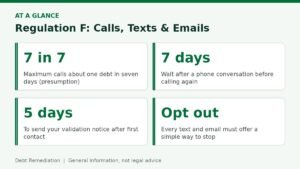
- A collector is presumed to violate the law if it calls you about a debt more than seven times in seven days, or within seven days after a phone conversation with you about that debt.
- Collectors can text and email you, but every electronic message must include a clear, simple way to opt out.
- Within five days of first contacting you, a collector must send a validation notice that itemizes the debt and explains your dispute rights.
- You control the channel. You can tell a collector not to contact you at a certain time, place or through a certain method, and it must honor that request.
When the federal Fair Debt Collection Practices Act (FDCPA) was passed in 1977, collection meant landline calls and letters. Text messages, email and social media did not exist. For decades, consumers and collectors argued over how old rules applied to new technology.
Regulation F, issued by the Consumer Financial Protection Bureau (CFPB), answered many of those questions. It sets clear expectations about how often collectors may call, when and how they can use electronic communication, and what information they must give you up front.
This guide walks through the rules that matter most when collectors contact you, and what you can do when they do not follow them.
Who Regulation F covers
Regulation F applies to the same companies covered by the FDCPA: third-party debt collectors, debt buyers, and attorneys who regularly collect consumer debts. It generally does not apply to an original creditor collecting its own debt in its own name, although state laws may impose similar limits on creditors.
It applies to consumer debts, such as credit cards, medical bills, personal loans, auto loans and mortgages, not business debts.
Phone calls: the “7-in-7” rule
The FDCPA has always prohibited calling repeatedly or continuously with intent to annoy, abuse or harass. Regulation F made that standard more concrete by creating a presumption based on call frequency.
A debt collector is presumed to comply with the law if it does both of the following for a particular debt:
- Places no more than seven telephone calls within seven consecutive days; and
- Does not place a call within seven consecutive days after having a telephone conversation with you about that debt.
A collector that exceeds either limit is presumed to violate the law. The presumption can be rebutted with evidence, and a collector staying within the limits can still violate the law if other facts show intent to harass. But the numbers give consumers a clear benchmark.
What counts as a “call”
- Calls that go unanswered, ring through to voicemail, or reach a busy signal count toward the seven-call limit.
- A call that results in a conversation with you starts the seven-day “cooling off” period.
- The limits apply per debt. If a collector is collecting several of your debts, the count is generally tracked separately for each one, although there are special rules for student loans.
- Calls you make to the collector, or calls you have expressly requested, generally do not count against the collector.
Example
A collector calls you on Monday, Tuesday, Wednesday, Thursday, Friday, Saturday and Sunday, and then again the following Monday morning. That eighth call within seven days exceeds the presumption. If, instead, you answered the Monday call and talked with the collector about the debt, the collector generally should not call you about that debt again until the following Monday.
Tip: Write down every call. A simple log of dates and times is the easiest way to show a pattern. A plain notebook or a simple spreadsheet works well.
Convenient times and places
Collectors may not contact you at a time or place they know, or should know, is inconvenient for you.
- Default hours: Contact before 8:00 a.m. or after 9:00 p.m. your local time is presumed inconvenient.
- Your stated preferences: If you tell a collector that a specific time is inconvenient, for example “Don’t call me before noon” or “Don’t call me on Sundays,” it must respect that.
- Your workplace: Collectors may not contact you at work if they know or have reason to know your employer prohibits it.
- Electronic messages: For emails and texts, the time that counts is when the message is sent, not when you read it.
Text messages
Regulation F confirms that collectors may contact you by text message, with conditions:
- Every text must include a clear and conspicuous, reasonable and simple way to opt out, such as replying “STOP.”
- If you opt out, the collector must stop texting you at that number.
- The collector must take steps to avoid texting a phone number that has been reassigned to someone else, and must follow procedures to protect your privacy.
- Texts are subject to the same rules against harassment, deception and unfair practices as any other communication.
Other laws, such as the federal Telephone Consumer Protection Act (TCPA), may also restrict automated texts and calls to your cell phone.
Collectors may also email you, but Regulation F includes safeguards meant to keep your debt private:
- Every email must include a clear and simple way to opt out of receiving further emails at that address.
- Collectors generally may not use an email address they know is provided by your employer, unless you used that address to communicate with them or gave them permission.
- Collectors must follow procedures designed to avoid sending emails that could be seen by third parties.
If you would rather be contacted only by mail, you can say so. A collector must honor a request not to use a particular communication medium.
Social media
Collectors may contact you through private messages on social media platforms, but:
- They must identify themselves as debt collectors when sending a friend or connection request.
- They may not communicate about your debt in any way that is viewable by the public or your contacts, such as posting on your wall or commenting on your posts.
- You can opt out of social media contact the same way you can opt out of texts and emails.
Voicemails and “limited-content messages”
To avoid revealing your debt to someone else who might hear a voicemail, Regulation F allows collectors to leave a “limited-content message.” Such a message may include only:
- Your name (or a business name that does not suggest debt collection);
- A request that you reply;
- The name of a person you can contact;
- A phone number; and, optionally,
- A salutation, the date and time, and a suggestion of how you can respond, such as by email or text.
A limited-content message is not considered a “communication” under the law, which means it does not trigger certain disclosure requirements. If a voicemail reveals details of the debt to a third party, such as a roommate or family member who hears it, keep a copy.
The validation notice: what collectors must tell you up front
One of Regulation F’s most important consumer protections is the validation notice. Within five days of a collector’s initial communication with you about a debt, unless it has already given you the information or you have paid the debt, the collector must provide written information that includes:
- The collector’s name and mailing address;
- The name of the creditor to whom the debt was owed on the itemization date, and, for consumer financial products, your account number;
- The name of the current creditor;
- An itemization showing the amount owed on the itemization date and any interest, fees, payments and credits since then;
- The current amount of the debt;
- The date by which you can dispute the debt (the end of the validation period); and
- Instructions for disputing the debt or requesting the name and address of the original creditor, often with a tear-off form you can return.
The CFPB published a model validation notice that many collectors use, so a compliant notice tends to look similar from company to company.
Your 30-day window
The validation period generally ends 30 days after you receive the notice. Collectors may assume you received it five days (excluding legal public holidays, Saturdays and Sundays) after it was sent. If you dispute the debt in writing within the validation period, the collector must stop collection until it sends you verification of the debt.
Respond within that window if anything looks wrong. Our guide to the debt validation letter explains exactly what to request.
Credit reporting: no “passive” reporting
Before Regulation F, some collectors would report a debt to the credit bureaus without ever contacting the consumer. Now, a collector may not furnish information about a debt to a consumer reporting agency before it has communicated with you about the debt, either by speaking to you or by sending you a letter or electronic message and waiting a reasonable period (generally 14 days) to see if it is undeliverable.
Time-barred debts
Regulation F prohibits debt collectors from suing or threatening to sue on a time-barred debt, meaning a debt for which the statute of limitations has expired. Be careful: in many states, a payment or written acknowledgment can affect the limitations period. Read our guide to time-barred debt before you pay anything on an old account.
How to use Regulation F to take control
- Keep a log of every call, text, email and letter.
- Read the validation notice carefully and calendar the dispute deadline.
- Dispute in writing within the validation period if anything is wrong or unfamiliar.
- State your preferences in writing: the times you can be contacted and the channels you want collectors to use or avoid.
- Opt out of texts or emails you do not want by using the opt-out method in each message.
- Ask the collector to stop contacting you entirely if you prefer, using a written cease-and-desist letter. Understand the trade-offs first.
- Report violations to the CFPB, the FTC and your state attorney general, and consider consulting a consumer protection attorney. Our guide to debt collector harassment explains what remedies may be available.
Keep learning
Our sister site, Debt Remediation Tools, explains what to do when collectors call in its free guide to dealing with debt collectors, and how to respond in writing in debt validation and disputes.
Frequently asked questions
It is a presumption. Calls above the limit are presumed to violate the law, but the collector can try to rebut the presumption. Calls within the limit can still be illegal if other facts show harassment.
Yes. However, automated calls and prerecorded messages to cell phones may be restricted by the Telephone Consumer Protection Act, and all calls must follow the FDCPA and Regulation F.
Yes. You can tell a collector not to use a specific medium, such as phone, email or text. It must honor that request.
If you do not dispute within the validation period, the collector may assume the debt is valid for collection purposes. That is not a court finding that you owe it, and you can still dispute later, but you lose the right to require the collector to pause collection until it verifies the debt.
Generally not under federal law, but many state laws regulate creditors’ collection practices, and other federal laws may apply.
The bottom line
Regulation F gives consumers clear, practical rights: a cap on how often collectors may call, the ability to opt out of texts and emails, protection from public social media contact, and a detailed validation notice that spells out what is owed and why. Knowing these rules lets you set boundaries, spot violations and respond with confidence.
If you are receiving collection contacts and are not sure the debt is accurate or belongs to the company demanding payment, contact Debt Remediation. We help consumers organize their records and prepare written requests that require collectors to back up their claims.
This article is for general educational purposes and is not legal advice. Debt Remediation is a service of Foxboro Consulting Group, Inc. and is not a law firm. Laws and regulations change; consult a licensed attorney about your specific situation.