
Key takeaways
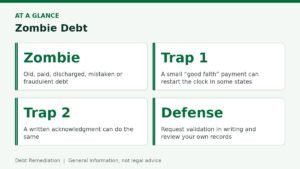
- “Zombie debt” is a nickname for a debt that should be dead but keeps coming back: a very old debt, one you already paid or settled, one discharged in bankruptcy, one that belongs to someone else, or one created by identity theft.
- Zombie debts often resurface after being sold several times to debt buyers whose records are thin or incomplete.
- The biggest traps are making a small “good faith” payment or acknowledging the debt in writing, which in some states can restart the clock for a lawsuit.
- Your best defenses are a written validation request, careful review of your own records, and a credit report dispute if the debt is reported inaccurately.
- Debt collectors may not sue or threaten to sue on time-barred debts, and they may not try to collect debts discharged in bankruptcy.
You open your mail and find a collection letter for an account you barely remember. Maybe it is a store card you closed a decade ago. Maybe it is a gym membership you are sure you canceled. Maybe you settled it years ago and have the paperwork somewhere. Or maybe you have never heard of the company at all.
Welcome to the world of zombie debt.
Zombie debt is not a legal term. It is a nickname consumer advocates use for debts that should be finished but keep rising from the grave. Understanding where they come from, and why they are so persistent, is the first step to stopping them.
Where zombie debt comes from
The debt-buying market
When a creditor gives up on collecting an account, it typically charges off the debt, writing it off as a loss for accounting purposes. Charge-off does not mean the debt disappears. The creditor may keep trying to collect, place the account with a collection agency, or sell it to a debt buyer, often for a small fraction of the balance.
Debt buyers sometimes resell portfolios to other buyers. Each time an account changes hands, the documentation can get thinner. A buyer may receive little more than a spreadsheet with names, balances and last-known addresses, without the original contract, statements, or a record of payments and disputes. Errors, duplicates and already-resolved accounts can slip through.
For a deeper look at this market, see our guide to who owns your debt and how debt buying works.
The most common types of zombie debt
- Time-barred debts. The statute of limitations for a lawsuit has expired. The debt may still exist, and a collector may still ask you to pay voluntarily, but it cannot lawfully sue or threaten to sue. Learn more in our guide to time-barred debt.
- Debts you already paid or settled. A creditor or buyer failed to update its records, or the account was sold before your payment posted.
- Debts discharged in bankruptcy. A bankruptcy discharge permanently bars collection of discharged debts as a personal liability of the debtor.
- Debts that belong to someone else. Same or similar names, a family member’s account, or an ex-spouse’s individual debt.
- Debts created by identity theft. Accounts opened in your name without your permission.
- Duplicate debts. The same account being collected by two companies at once, or the original creditor and a collector both reporting it.
Why zombie debt is dangerous
It might be tempting to ignore a collection letter for a debt you know is ancient or already resolved. But zombie debts can still cause real harm:
- Lawsuits. Some debt buyers file large volumes of lawsuits. If you do not respond, the court can enter a default judgment against you, even on a debt you do not owe or one that is time-barred. The statute of limitations is often a defense you must raise yourself.
- Credit reporting. A collector may report the account to the credit bureaus. Negative information generally cannot be reported more than about seven years from the date of first delinquency, but a collector that reports an incorrect date (“re-aging”) can keep it on your report longer than allowed.
- Accidental revival. In some states, a payment, a promise to pay, or a written acknowledgment can restart the statute of limitations, turning a debt that could not be sued on into one that can.
Red flags that a debt might be a zombie
- You do not recognize the creditor or the account.
- The balance is much higher than you remember, with large added interest or fees.
- The collector cannot or will not tell you the original creditor, the date of last payment, or the charge-off date.
- The letter offers a large discount or “limited-time settlement” on a very old account.
- The collector urges you to make a small payment “to show good faith” or to “stop the calls.”
- You receive letters from two different companies about what looks like the same debt.
- The account appeared on your credit report recently even though it dates back many years.
The two biggest traps to avoid
Trap 1: The “good faith” payment
A collector may suggest that even $25 would help. On a time-barred debt, that small payment can, in some states, restart the statute of limitations and expose you to a lawsuit for the entire balance. Do not pay anything on an old debt until you know:
- whether it is yours;
- whether you already paid or settled it;
- whether it is time-barred in your state; and
- what effect a payment would have.
Trap 2: Acknowledging the debt in writing
In some states, a written acknowledgment or promise to pay can also revive the limitations period. Keep your communications neutral. Ask for information; do not admit the debt or promise payment.
How to stop zombie debt: a step-by-step plan
Step 1: Don’t panic, and don’t pay yet
Collectors count on urgency. You have time to gather facts, especially if you act within the dispute window in the collector’s validation notice.
Step 2: Check your own records
Look for: – old account statements; – settlement letters or “paid in full” letters; – bank statements showing payments; – bankruptcy discharge orders and the schedules listing the debt; – identity theft reports; and – divorce decrees that assign responsibility for specific debts.
Step 3: Send a written validation request
If you are within the 30-day validation period after the collector’s first notice, send a written dispute and request for verification. Ask for the original creditor, the date of default or charge-off, the date of your last payment, an itemization of the balance, and proof of the collector’s right to collect. Our debt validation letter guide walks through what to ask for. Send it by certified mail and keep copies.
Even if you are outside the 30-day window, you can still dispute the debt and request information. The collector is simply not required to pause collection while it responds.
Step 4: Determine whether the debt is time-barred
Find the date of your last payment or default and compare it with your state’s statute of limitations for the type of debt. (In Massachusetts, for example, the limit for most consumer contract debts is currently six years; a pending bill would shorten that, so check the current law.) Remember that the limitations period for a lawsuit is different from the credit reporting time limit.
Step 5: Respond based on what you find
| What you find | What to do |
|---|---|
| You already paid or settled it | Send the collector a copy (never the original) of your proof of payment or settlement letter and ask it to close the account and correct any credit reporting. |
| It was discharged in bankruptcy | Send a copy of the discharge order and the schedule listing the debt. Continued collection may violate the bankruptcy discharge injunction; consider contacting your bankruptcy attorney. |
| It’s not yours | Dispute in writing and state that the debt is not yours. |
| It’s identity theft | File a report at IdentityTheft.gov, place a fraud alert or credit freeze, and send the collector a copy of your identity theft report. |
| It’s time-barred | You may choose not to pay. A collector may not sue or threaten to sue. Consider a written request that it stop contacting you. |
| It’s valid and within the limitations period | Consider your options: negotiate, set up a payment plan, or seek advice before deciding. |
Step 6: Fix your credit report
If the zombie debt appears on your credit report with incorrect information, such as a wrong date of first delinquency, a balance on a paid account, or an account that is not yours, dispute it directly with each credit bureau reporting it. Our guide to disputing a collection account on your credit report explains the process.
Step 7: Tell the collector to stop, if needed
Once you have the facts, you can send a cease-and-desist letter requiring the collector to stop most communication.
Step 8: Never ignore a lawsuit
If you are served with a summons, respond by the deadline, even if you are certain the debt is a zombie. Raise defenses like the statute of limitations, payment, discharge or mistaken identity in your answer. See our guide to answering a debt collection lawsuit.
Your legal protections
- Fair Debt Collection Practices Act (FDCPA): prohibits collectors from misrepresenting the character, amount or legal status of a debt, and from suing or threatening to sue on time-barred debt (as clarified by the CFPB’s Regulation F).
- Fair Credit Reporting Act (FCRA): limits how long negative information can be reported and requires investigation of disputes.
- Bankruptcy Code: the discharge injunction bars collection of discharged debts as a personal liability.
- State laws: many states, including Massachusetts, regulate collectors and debt buyers and may provide additional rights.
Check the clock on an old debt
Time limits for suing on a debt vary by state. Look up yours with our free statute of limitations by state guide, then read how to validate and dispute a debt.
Frequently asked questions
Generally, yes. It may ask you to pay voluntarily, but it may not sue or threaten to sue, and it may not misrepresent the debt’s legal status.
Possibly. In some states a payment can restart the statute of limitations. Get the facts before paying anything.
Most negative accounts may be reported for up to about seven years from the original delinquency. Selling the debt or making a payment should not reset that reporting period.
Request validation from both. Only one party can own the debt. Paying the wrong one does not discharge your obligation to the right one.
The bottom line
Zombie debts thrive on confusion and urgency. Slow down, ask for proof in writing, compare it with your records, and do not make payments or promises until you understand what you are dealing with.
If an old or unfamiliar debt has resurfaced and you want help organizing your records and preparing written requests, contact Debt Remediation.
This article is for general educational purposes and is not legal advice. Debt Remediation is a service of Foxboro Consulting Group, Inc. and is not a law firm. Statutes of limitations and revival rules vary by state; consult a licensed attorney about your specific situation.