
Key takeaways
- The Fair Credit Reporting Act (FCRA) gives you the right to dispute inaccurate or incomplete information on your credit reports, free of charge.
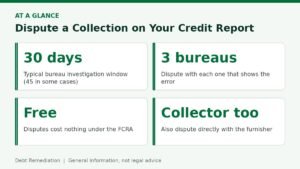
- Credit bureaus generally must investigate within 30 days (45 days in some situations) and must delete or correct information that is inaccurate or cannot be verified.
- Common errors on collection accounts include debts that aren’t yours, wrong balances, duplicate listings, paid accounts showing a balance, and incorrect delinquency dates that keep old debts on your report too long.
- Dispute with each bureau that shows the error, and consider disputing directly with the collector (the “furnisher”) as well.
- Accurate negative information generally cannot be removed early just because you dispute it. A dispute is a tool for fixing errors, not erasing history.
A collection account can drag down your credit scores and affect your ability to rent an apartment, get a car loan or qualify for a mortgage. When that collection is wrong, it is not just frustrating. It is something the law gives you the right to fix.
This guide explains how to spot errors in collection accounts, how to dispute them under the Fair Credit Reporting Act, and how to escalate if the credit bureaus or collectors do not correct the problem.
Step 1: Get all three of your credit reports
You can get free credit reports from Equifax, Experian and TransUnion at AnnualCreditReport.com, the official site authorized by federal law. Free weekly access is now permanently available there.
Pull all three. Collectors do not always report to every bureau, and errors on one report may not appear on the others.
Step 2: Review each collection account carefully
For every collection account, look at:
| Item | What to check |
|---|---|
| Account owner | Is this your debt? Do you recognize the original creditor? |
| Original creditor | Is it listed? Does it match your records? |
| Collector/furnisher name | Is the current collector or debt buyer identified? |
| Balance | Does it match what you owe? Is a paid account showing a balance? |
| Status | Is a paid or settled account still shown as unpaid? Is a disputed debt marked as disputed? |
| Date of first delinquency | This date controls how long the account can stay on your report. Is it accurate? |
| Date opened / date assigned | Has the collector reported the date it acquired the debt as if it were the date of delinquency? |
| Duplicates | Is the same debt listed twice, by the original creditor and a collector, or by two collectors, both showing balances? |
| Bankruptcy | If discharged in bankruptcy, does it show a zero balance and “discharged in bankruptcy”? |
Understanding the seven-year rule
Under the FCRA, most negative information, including collection accounts, can be reported for up to seven years. For collection accounts and charge-offs, the seven-year period is measured from 180 days after the date of first delinquency on the original account, the date you first fell behind and never caught up.
That clock does not restart when: – the debt is sold to a new buyer; – a new collector takes over; or – you make a partial payment.
A collector that reports a later delinquency date to keep an old debt on your report longer is engaged in what is called “re-aging,” which violates the FCRA. Re-aging is a common feature of zombie debt.
Don’t confuse two clocks. The seven-year credit reporting period is separate from your state’s statute of limitations for lawsuits. A debt can fall off your credit report and still be legally collectible, or be time-barred for lawsuits and still appear on your report. See our guide to time-barred debt.
Step 3: Gather your evidence
Before filing a dispute, collect documents that support your position:
- payment confirmations, cancelled checks or bank statements;
- settlement agreements or “paid in full” letters;
- bankruptcy discharge orders and schedules;
- identity theft reports from IdentityTheft.gov or a police report;
- correspondence with the original creditor showing the correct delinquency date;
- your validation request and any response (or lack of response) from the collector; and
- insurance explanation-of-benefits forms for medical collections.
Make copies. Never send originals.
Step 4: File your dispute with each credit bureau
You can dispute online, by mail or by phone with each bureau. Each method has trade-offs:
- Online is fastest and lets you track progress, but some online forms limit how much you can explain and may route you into narrow categories.
- By mail takes longer but lets you include a detailed letter and supporting documents, and creates a clear paper trail. Send by certified mail with return receipt.
What to include in a dispute letter
- Your full name, address and date of birth, plus proof of identity and address (such as a copy of a driver’s license and a utility bill), as the bureau requests.
- A list of each item you dispute, identified by the creditor or collector name and account number (the partial number shown on your report is fine).
- A clear explanation of why each item is inaccurate or incomplete. Be specific: “This account was paid in full on March 3, 2024; see enclosed letter,” or “The date of first delinquency was June 2018, not June 2021.”
- What you want done: delete the account, or correct a specific field.
- Copies of your supporting documents.
- A copy of your credit report with the disputed items circled or highlighted.
Sample dispute paragraph
I am disputing the collection account reported by [Collector Name], account ending in [last 4 digits]. This account is inaccurate because [the debt was paid in full on (date) / I have never had an account with (original creditor) / the date of first delinquency is reported as (date) but the account first became delinquent in (date)]. I have enclosed [list documents]. Please [delete this account / correct the reported date of first delinquency] as required by the Fair Credit Reporting Act.
Step 5: Dispute directly with the furnisher, too
Under the FCRA and its regulations, you can also send a dispute directly to the company that furnished the information, such as the collection agency or debt buyer. Furnishers must investigate direct disputes about the accuracy of information they report, with some exceptions.
Disputing with both the bureaus and the furnisher can increase the chance of a correction. Include the same documentation.
If you are still within the validation period after the collector’s first notice, a debt validation letter can be sent at the same time. A collector that knows a debt is disputed must report it as disputed if it reports the debt at all.
Step 6: Understand the investigation process
Once a bureau receives your dispute:
- It must generally complete its investigation within 30 days. That can extend to 45 days if you send additional relevant information during the 30-day period, or in some cases if the dispute follows a free annual report.
- It must forward your dispute and relevant information to the furnisher within five business days.
- The furnisher must investigate and report back.
- If the information is inaccurate, incomplete or cannot be verified, the bureau must delete or modify it.
- The bureau must send you written results within five business days after completing the investigation, along with a free copy of your report if it changed.
A bureau may decline to investigate a dispute it reasonably determines is “frivolous or irrelevant,” such as one that lacks enough information to investigate. It must notify you within five business days if it does so. That is why specific explanations and documentation matter.
Step 7: If the dispute fails, escalate
If the bureau “verifies” the information but you still believe it is wrong:
- Ask how the information was verified. You have the right to request a description of the procedure used, including the name, address and phone number of the furnisher, if reasonably available.
- Send a second, more detailed dispute with additional documentation.
- Add a statement of dispute. You can ask the bureau to include a brief statement (up to 100 words) on your report explaining your position.
- File a complaint with the Consumer Financial Protection Bureau at consumerfinance.gov/complaint. Bureaus and furnishers must respond to CFPB complaints.
- Contact your state attorney general.
- Consult a consumer protection attorney. The FCRA allows consumers to recover actual damages and, for willful violations, statutory damages between $100 and $1,000, punitive damages and attorney’s fees.
What about “pay for delete”?
Some consumers try to negotiate a “pay for delete,” paying a collector in exchange for removing the account from their credit report. The practice is not illegal for consumers, but:
- collectors’ agreements with credit bureaus generally require them to report accurate information, so many refuse;
- an agreement may not be honored, so get any agreement in writing before paying; and
- newer credit scoring models, including FICO Score 9 and 10 and VantageScore 3.0 and 4.0, already ignore paid collection accounts, while older models still used by many lenders do not.
If you settle or pay a valid collection, ask the collector to update the account to show a zero balance and a “paid” or “settled” status.
Special cases
Medical collections. The three major credit bureaus no longer include paid medical collection debt or medical collection debt with an initial reported balance under $500, and they wait a year before reporting unpaid medical collections. A 2025 federal rule that would have gone further was vacated by a federal court, and several states have their own medical debt reporting laws. See our guide to medical debt rights.
Identity theft. Under the FCRA, you can ask bureaus to block information resulting from identity theft if you provide an identity theft report. Visit IdentityTheft.gov to create one.
Bankruptcy. Debts discharged in bankruptcy should show a zero balance. A collection account still showing a balance after discharge is inaccurate.
Put your dispute in writing
Our free guide to debt validation and disputes on Debt Remediation Tools explains how to challenge a debt with the collector as well as the credit bureaus.
Frequently asked questions
Generally not through a dispute. Accurate information can be reported for the time allowed by law. However, you can dispute any detail that is inaccurate, and you may ask the creditor for a goodwill adjustment.
No. Filing a dispute does not lower your score.
Mail is slower but creates a better paper trail and lets you include documents and detailed explanations. Many consumers use mail for complex disputes.
Up to seven years from 180 days after the original date of first delinquency, regardless of sale or payment.
Not automatically. It should be updated to show a zero balance. Some newer scoring models ignore paid collections.
The bottom line
Your credit report should tell an accurate story. When a collection account is wrong, the FCRA gives you a clear process to fix it: get your reports, document the error, dispute with each bureau and the furnisher, and escalate if needed. Once errors are cleared, you can focus on rebuilding your credit.
If collection accounts are piling up and you are not sure which ones are accurate, Debt Remediation can help you organize your records and prepare written requests to collectors.
This article is for general educational purposes and is not legal advice. Debt Remediation is a service of Foxboro Consulting Group, Inc. and is not a law firm or credit repair organization. Consult a licensed attorney about your specific situation.