
Key takeaways
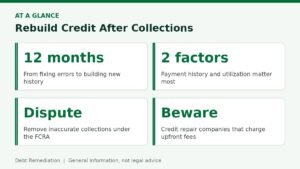
- Collection accounts hurt credit scores most when they are new. Their impact fades over time, especially as you add positive history.
- Start by fixing errors. Inaccurate collection accounts can be disputed and removed under the Fair Credit Reporting Act.
- Your payment history and credit utilization are the two biggest factors in common FICO scoring models. Focus there first.
- Tools like secured credit cards, credit-builder loans and becoming an authorized user can help you build new positive history.
- Be wary of credit repair companies that charge upfront fees or promise to remove accurate information. Federal law restricts how they operate.
Getting through a period of collection calls, lawsuits or settlements is exhausting. When the dust settles, many people look at their credit report and wonder whether it will ever recover.
It will. Credit scoring models are designed to weigh recent behavior more heavily than older problems. With a clear plan and consistent habits, most people can make meaningful progress within a year, and substantial progress within two or three.
This guide lays out a practical, month-by-month plan.
How collections affect your credit
Credit scores are calculated from the information in your credit reports. For FICO Scores, the most widely used scores, the general weighting is:
| Factor | Approximate weight |
|---|---|
| Payment history | 35% |
| Amounts owed (including credit utilization) | 30% |
| Length of credit history | 15% |
| New credit | 10% |
| Credit mix | 10% |
A collection account damages the payment history category. Its effect is strongest in the first year or two and declines over time. Collection accounts can generally be reported for up to seven years from 180 days after the original date of first delinquency.
Importantly, scoring models differ: – FICO Score 9 and 10 and VantageScore 3.0 and 4.0 ignore paid collection accounts. – Older FICO models still used by many lenders, including many mortgage lenders, still count paid collections. – Medical collections are treated differently by the major credit bureaus, which no longer report paid medical collections or those with an initial balance under $500.
Month 1: Get your reports and fix errors
Pull all three credit reports
Get free reports from Equifax, Experian and TransUnion at AnnualCreditReport.com. Review every account.
Dispute anything inaccurate
Look for: – collection accounts that aren’t yours; – paid or settled debts still showing a balance; – duplicate listings of the same debt; – wrong dates of first delinquency (which can keep old debts on your report too long); and – debts discharged in bankruptcy that still show a balance.
Our step-by-step guide to disputing a collection account on your credit report explains how. Removing even one inaccurate collection can make a noticeable difference.
Check for zombie debts
If an old debt has resurfaced, don’t pay it until you understand whether it is yours and whether it is past the statute of limitations. See our guides to zombie debt and time-barred debt.
Month 1 to 2: Stabilize your budget
You can’t build credit on a shaky foundation. Before opening new accounts:
- Build a realistic budget that covers essentials and minimum payments. Our free Debt Payoff Calculator shows how long your balances take to clear at different monthly payments.
- Set aside a starter emergency fund, even a few hundred dollars, so an unexpected expense doesn’t lead to missed payments.
- Set up automatic payments for at least the minimum due on every account you keep.
Month 2 to 3: Make every current account a positive one
Never miss another payment. Payment history is the single most important factor. A single 30-day late payment can set back months of progress.
- Turn on autopay for minimum payments.
- Set calendar reminders a few days before each due date.
- If you can’t make a payment, call the creditor before the due date to ask about options.
Month 2 to 4: Lower your credit utilization
Credit utilization is the percentage of your available revolving credit that you’re using. It’s a major part of the “amounts owed” category.
Example: You have two credit cards with a combined limit of $5,000 and combined balances of $2,500. Your utilization is 50%. Paying the balances down to $500 lowers it to 10%.
General guidelines: – Below 30% is commonly recommended. – Below 10% is associated with the highest scores. – Both overall and per-card utilization matter.
Utilization has no long-term memory in most scoring models: once your balances drop and the new balances are reported, your score can improve quickly. To see where you stand, divide your total card balances by your total credit limits. Lenders also look at your debt-to-income ratio, which you can check with our free calculator.
Tips: – Pay down balances before the statement closing date, since that’s usually when the balance is reported. – Make multiple payments during the month if needed. – Don’t close old cards with zero balances unless they carry an annual fee you can’t justify. Closing them reduces your available credit and can raise utilization.
Month 3 to 6: Add new positive credit history
If collections left you with few active accounts, you’ll need new positive history. Consider:
Secured credit card
You make a refundable deposit, often $200 to $500, which usually becomes your credit limit. Use it for a small recurring purchase, pay it in full every month, and confirm the issuer reports to all three credit bureaus. Many issuers review accounts after six to twelve months for an upgrade to an unsecured card and a refund of the deposit.
Credit-builder loan
Offered by many credit unions and community banks. The lender holds the loan amount in a savings account while you make monthly payments. Once paid off, you receive the funds. Each on-time payment is reported as positive history.
Authorized user
A trusted family member with a long, positive history and low utilization can add you as an authorized user on a credit card. Their positive account history may appear on your report. Be sure their habits are strong; their late payments could affect you too.
Rent and utility reporting
Some services report on-time rent and utility payments to one or more credit bureaus. Not all scoring models count them, but they can help, especially for thin credit files.
Go slowly. Each new credit application can cause a small, temporary dip from a hard inquiry, and new accounts lower the average age of your credit. One or two new accounts in a year is usually plenty.
Month 6 to 12: Address remaining collections strategically
Decide what to do about valid collection accounts that remain:
- Recent, valid debts within the statute of limitations: Consider settling or paying them, especially if you plan to apply for a mortgage soon. Get any agreement in writing, and ask that the account be updated to a zero balance.
- Old debts near the end of the seven-year reporting period: Paying may not improve your score much under older models. Weigh the pros and cons.
- Time-barred debts: Be careful. In some states, a payment can restart the statute of limitations for a lawsuit.
Keep in mind that forgiven debt may be taxable. See our guide to Form 1099-C and canceled debt.
Month 12 and beyond: Keep building
- Check your reports regularly for new errors.
- Monitor your scores; many banks and card issuers provide free scores.
- Keep utilization low and pay on time, every time.
- Let your accounts age. Length of history improves on its own.
- Revisit your budget as your income and expenses change.
Beware of credit repair scams
Many companies promise to “erase bad credit” quickly. Be cautious. Under the federal Credit Repair Organizations Act (CROA), credit repair companies:
- may not charge you before they have performed the promised services;
- must give you a written contract that explains your rights;
- must allow you to cancel within three business days without charge; and
- may not make false claims, including promising to remove accurate, timely negative information.
Red flags include demands for upfront payment, advice to dispute accurate information, suggestions to create a “new identity” with an EIN or CPN, and pressure to act quickly. Anything a legitimate credit repair company can do, you can do yourself for free.
Realistic expectations
There is no single timeline for everyone. Factors include how many negative items are on your report, how recent they are, and what positive history you have. But a common pattern is:
- 1 to 3 months: Errors removed and utilization lowered can produce visible gains.
- 6 to 12 months: New positive accounts begin to carry weight.
- 2 to 3 years: Older negatives have much less impact; scores can approach “good” ranges with consistent habits.
- 7 years: Most collection accounts age off your reports entirely.
Track your progress with the numbers
Lenders weigh your debt against your income. Check yours with the free Debt-to-Income Calculator, then use the Debt Payoff Calculator to see how quickly your remaining balances can be cleared.
Frequently asked questions
Under newer scoring models (FICO 9/10, VantageScore 3.0/4.0), paid collections are ignored, so yes. Under older models, paying may not change your score much, but it can still matter to lenders reviewing your report.
Usually not, unless they have fees you can’t justify. Open accounts with zero balances help your utilization and credit age.
Many people see meaningful improvement within 12 months of on-time payments and low utilization. Full recovery can take several years.
You can do everything a legitimate credit repair company can do yourself, for free. If you hire one, make sure it follows the Credit Repair Organizations Act.
The bottom line
Collection accounts are a setback, not a life sentence. Clear up errors first, stabilize your budget, pay every account on time, keep utilization low, and add positive history slowly. Time and consistency do the rest.
If you’re still dealing with collection accounts and want help confirming which are accurate before you decide what to pay, contact Debt Remediation.
This article is for general educational purposes and is not legal or financial advice. Debt Remediation is a service of Foxboro Consulting Group, Inc. and is not a law firm or credit repair organization. Credit scoring models and lender practices change; results vary.