
Key takeaways
- Under the federal Fair Debt Collection Practices Act (FDCPA), you can tell a debt collector in writing to stop communicating with you, and it generally must comply.
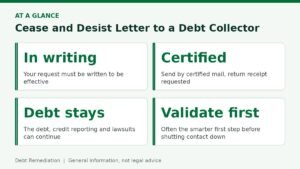
- A cease and desist letter stops most calls, letters, texts and emails. It does not erase the debt, stop credit reporting, or prevent a lawsuit.
- In many situations, sending a debt validation letter first is the smarter move, because it forces the collector to prove the debt before you shut down communication.
- Send the letter by certified mail with return receipt, keep copies, and log any contact that happens afterward.
- The FDCPA covers third-party collectors and debt buyers, not usually original creditors collecting their own accounts.
Constant collection calls can make it hard to think clearly. For many people, the first question is simple: How do I make them stop?
Federal law gives you a direct answer. Section 805(c) of the Fair Debt Collection Practices Act allows you to notify a debt collector in writing that you want it to stop communicating with you, or that you refuse to pay the debt. Once the collector receives that notice, it must generally stop contacting you.
That is powerful. But a cease and desist letter is a tool with trade-offs, and using it at the wrong time can leave you with less information and less room to negotiate. This guide explains how it works, when it makes sense, what can go wrong, and how to write one.
What a cease and desist letter does
When a debt collector receives your written request to stop communicating, it must stop contacting you about that debt, with three exceptions. The collector may still contact you to:
- Tell you it is ending its collection efforts;
- Notify you that it or the creditor may use specific remedies it ordinarily uses, such as filing a lawsuit; or
- Notify you that it intends to use a specific remedy, such as filing suit.
In practical terms, the calls, texts and routine letters should end. What you may still receive is notice that the collector is closing your file, returning it to the creditor, or taking legal action.
Under Regulation F, the CFPB’s rule implementing the FDCPA, a request made by email can also qualify as a written request if the collector accepts email communication from consumers. Even so, certified mail creates the clearest proof of what you sent and when it was received.
What a cease and desist letter does not do
Understanding the limits will help you avoid surprises:
- It does not cancel or reduce the debt. If you owe the money, you still owe it.
- It does not stop a lawsuit. A collector that cannot call or write may decide that suing is the only way left to collect.
- It does not stop credit reporting. The account may remain on your credit report, although if you have disputed the debt the collector must report it as disputed.
- It does not necessarily apply to the original creditor. The FDCPA generally does not cover a creditor collecting its own debt, although some state laws do.
- It does not stop a new collector. If the account is sold or placed with a different agency, you may need to send a new letter.
- It does not stop the statute of limitations clock or restart it. It simply has no direct effect on that clock.
When sending a cease and desist letter makes sense
A cease and desist letter is often a good choice when:
- The contact is harassing, abusive or overwhelming, and you need it to stop to protect your health, job or family relationships.
- The debt is past the statute of limitations for a lawsuit in your state, so the risk of being sued is low. (A collector may not sue or threaten to sue on a time-barred debt. Learn more in our guide to time-barred debt.)
- You do not recognize the debt and have already disputed it, and you have decided you do not want further contact.
- You are working with an attorney and want all communication to go through counsel. In that case, a simpler option is to tell the collector you are represented and provide your attorney’s contact information; the collector generally must then communicate only with your attorney.
- You have no income or assets that a creditor could reach (sometimes called being “judgment proof”) and you want peace while you rebuild. Speak with a consumer attorney before relying on this.
When a cease and desist letter can backfire
There are situations where shutting down communication could work against you:
- You haven’t requested validation yet. If you stop contact before the collector has proven the debt, you lose the chance to see what records it has. In most cases, send a debt validation request within the 30-day validation period first.
- You want to negotiate a settlement or payment plan. Once you ask the collector to stop communicating, it cannot reach out with offers. You can still contact the collector yourself, but you lose some flexibility.
- The debt is recent and the collector is likely to sue. Cutting off contact can push the account toward litigation faster. If you are sued, you must respond by the court’s deadline, or you risk a default judgment.
- You might miss important information, such as a settlement deadline or notice that the account has been transferred.
Our view: For most consumers, the best sequence is validate first, then decide. A debt validation letter preserves your rights and forces the collector to show its proof. If the collector cannot or will not verify the debt, or if contact continues to be abusive, a cease and desist letter is the next step.
Validation letter vs. cease and desist letter
| Debt validation letter | Cease and desist letter | |
|---|---|---|
| Main purpose | Make the collector prove the debt | Stop most communication |
| Best timing | Within 30 days of the validation notice | After validation, or when contact is abusive |
| Effect on collection | Collector must pause until it sends verification (if sent in time) | Collector must stop contacting you, with limited exceptions |
| Keeps negotiation open? | Yes | Mostly no (you can still initiate contact) |
| Stops a lawsuit? | No | No |
| Stops credit reporting? | No, but disputed debts must be reported as disputed | No |
What to include in a cease and desist letter
Keep the letter short, factual and professional. Include:
- Your full name and mailing address (the address the collector has on file).
- The date.
- The collector’s name and address, taken from its most recent letter.
- The account or reference number the collector uses. Never include your full Social Security number.
- A clear statement that you are requesting that it cease all communication with you about the debt, under the FDCPA.
- Optional: a statement that you dispute the debt, if you do.
- Optional: your communication preferences, if you want to allow some contact, such as mail only.
- Your signature.
Avoid admitting that the debt is yours, promising to pay, or explaining your financial situation in detail. In some states, a written acknowledgment of a debt can affect the statute of limitations.
Sample cease and desist letter
[Your Full Name] [Your Street Address]
[City, State ZIP][Date]
Sent by Certified Mail, Return Receipt Requested
[Debt Collector’s Name]
[Collector’s Street Address]
[City, State ZIP]Re: Account/Reference No. [number from the collector’s letter]
To Whom It May Concern:
Pursuant to my rights under the Fair Debt Collection Practices Act, 15 U.S.C. § 1692c(c), I request that you cease all communication with me regarding the account referenced above.
[Optional: I dispute this debt. This letter is not an acknowledgment that I owe the amount you claim, or any amount.]
This request applies to all forms of communication, including telephone calls, text messages, emails, social media messages and letters, except as expressly permitted by 15 U.S.C. § 1692c(c).
[Optional: If you are required to contact me as permitted by law, do so only in writing at the mailing address above.]
Please note that I am keeping a record of all communication regarding this account.
Sincerely,
[Signature]
[Printed Name]
Adapt the bracketed sections to your situation. If you are unsure whether the optional dispute language fits your circumstances, speak with a consumer attorney.
How to send your letter
- Make a copy of the signed letter for your records.
- Send it by USPS Certified Mail with Return Receipt (the green card or electronic return receipt). Keep the receipt and tracking number.
- Calendar the delivery date. The collector’s obligation begins once it receives the letter.
- Store everything together: your copy, the mailing receipt, the return receipt and the collector’s letters.
What to do if the collector keeps contacting you
If contact continues after the collector received your letter (other than the limited permitted notices):
- Log each contact with the date, time, method, phone number or email address, and what was said.
- Save voicemails, texts and emails.
- File complaints with the Consumer Financial Protection Bureau, the Federal Trade Commission and your state attorney general.
- Consult a consumer protection attorney. Continued contact after a valid cease request may be an FDCPA violation, which can entitle you to actual damages, statutory damages of up to $1,000 and attorney’s fees. Learn more in our guide to debt collector harassment.
If you are sued after sending the letter
Do not ignore it. A lawsuit is a separate legal process with strict deadlines. Read the summons carefully, note the response date, and consider consulting an attorney. Our step-by-step guide on how to answer a debt collection lawsuit explains what to expect.
Before you send a letter
Not sure whether to dispute first or tell the collector to stop? Our free guides on debt validation and disputes and dealing with debt collectors walk through both options.
Frequently asked questions
Under Regulation F, an email can count as a written request if the collector accepts email from consumers. Certified mail is still the safest way to prove delivery.
No. Credit reporting is separate. If information on your report is inaccurate, you can dispute it with the credit bureaus.
The FDCPA generally does not cover original creditors collecting their own debts. Some state laws provide similar rights, and creditors often honor written requests anyway.
Yes. A new owner or agency may contact you. Send a new letter to that company if you want contact to stop.
Usually validation first, especially within 30 days of the collector’s first notice. Then decide whether to stop communication.
The bottom line
A cease and desist letter gives you real control over how and whether a debt collector contacts you. Used at the right time, it can bring immediate relief. Used too early, it can cut off information you need and nudge an account toward court. Think of it as one step in a larger plan: verify the debt, document everything, and decide your next move with facts in hand.
Debt Remediation provides letter templates, guidance and full-service support for consumers who want to respond to collectors methodically. Get in touch to learn which option fits your situation.
This article is for general educational purposes and is not legal advice. Debt Remediation is a service of Foxboro Consulting Group, Inc. and is not a law firm. The sample letter is provided for information only; consult a licensed attorney about your specific situation.